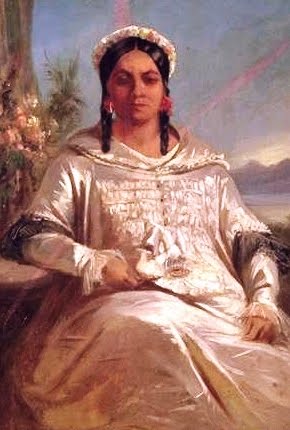
 Today's entries contain the longest and possibly one of the most interesting entries in Fitzroy's Journal: his meeting with the Queen of Tahiti. It is well worth reading in its entirety.
Tahiti
About two years ago a small vessel under English colors was plundered by the inhabitants of the Low Islands, which were then under the dominion of the Queen of Tahiti. — It is believed they were instigated to this act by some indiscreet laws issued by Her Majesty. — The British Government demanded compensation; this was acceeded to & a sum nearly equal to 3000 dollars was agreed to be paid on the first of last September. — The Commodore at Lima ordered Capt. FitzRoy to enquire concerning this debt & to demand satisfaction if not paid. — Capt. FitzRoy asked for an interview with the Queen: — For this purpose a Parliament was held where all the principal chiefs of the Island & the Queen were assembled. I will not attempt to describe what took place, as so interesting an account has been given by Capt. FitzRoy. The money had not been paid: —perhaps the alledged reasons were rather equivocating; otherwise I cannot sufficiently express our general surprise at the extreme good sense; reasoning powers, moderation, candor & prompt resolution which were displayed on all sides. — I believe every one in our party left the meeting with a very different opinion of the Tahitians from what he entertained when entering. — The chiefs & people resolved to subscribe & complete the sum which was wanting. — Capt. FitzRoy urged that it was hard that their private property should be sacrificed for the crimes of distant Islanders. They replied that they were grateful for his consideration, but that Pomarre was their queen, & they were determined to help her in this her difficulty. — This resolution & its prompt execution, for a book was opened early the next morning, is an uncommon instance of loyalty. After the main discussion was ended, several of the chiefs took the opportunity of asking Capt. FitzRoy many intelligent questions concerning international customs & laws. These related to the treatment of ships & foreigners. On some points, as soon as their decision was made, the law was issued verbally on the spot. — This Tahitian parliament lasted for several 649 hours and when it was over Capt. FitzRoy invited the Queen to pay the Beagle a visit. — We all dined with Mr Pritchard, & after it was dark pulled back to the ship.
Captain Fitzroy’s Journal
With all the officers who could be spared from the duty of the ship, Mr. Darwin and I repaired early to Papiete. Mr. Wilson, Mr. Henry, and Hitote, were of the party. Arrived at the hospitable abode of Mr. Pritchard, we waited until a messenger informed us of the queen's arrival at the appointed place of meeting—the English chapel. From our position we had just seen the royal escort—a very inferior assemblage. It appeared that the chiefs and elderly people had walked to the chapel when our boats arrived, leaving only the younger branches of the community to accompany Pomare. The English chapel is a small, wooden structure, with a high, angular roof; it is about fifty feet in length and thirty feet wide; near the eastern end is a pulpit, and at each corner a small pew. The rest of the building is occupied by strong benches, extending nearly from side to side; latticed windows admit light and air; the roof is thatched in a partly Otaheitan manner; none of the woodwork is painted, neither is there any decoration. Entering the chapel with my companions, I turned towards the principal pews, expecting to see Pomare there; but no, she was sitting almost alone, at the other end of the building, looking very disconsolate. Natives sitting promiscuously on the benches saluted us as we entered:—order, or any kind of form, there was none.
The only visible difference between Pomare and her subjects was her wearing a gay silk gown, tied however round the throat, though entirely loose elsewhere; being made and worn like a loose smock-frock, its uncouth appearance excited more notice from our eyes than the rich material. In her figure, her countenance, or her manner, there was nothing prepossessing, or at all calculated to command the respect of foreigners. I thought of Oberea,* and wished that it had been possible to retain a modified dress of the former kind. A light undergarment added to the dress of Oberea might have suited the climate, satisfied decency, and pleased the eye, even of a painter.
Disposed at first to criticise rather ill-naturedly—how soon our feelings altered, as we remarked the superior appearance and indications of intellectual ability shown by the chieftains, and by very many of the natives of a lower class. Their manner, and animated though quiet tone of speaking, assisted the good sense and apparent honesty of the principal men in elevating our ideas of their talents, and of their wish to act correctly.
Every reader of voyages knows that the chiefs of Otaheite are large, fine-looking men. Their manner is easy, respectful, and to a certain degree dignified; indeed on the whole surprisingly good. They speak with apparent ease, very much to the purpose in few words, and in the most orderly, regular way. Not one individual interrupted another; no one attempted to give his opinions, or introduce a new subject, without asking permission; yet did the matters under discussion affect them all in a very serious manner. Might not these half-enlightened Otaheitans set an example to numbers whose habits and education have been, or ought to have been, so superior?
It had become customary to shake hands with the queen, as well as with the chiefs. This compliment we were expected to pay; but it seemed difficult to manage, since Pomare occupied a large share of the space between two benches nearest to the wall, and the next space was filled by natives. However, squeezing past her, one after another, shaking hands at the most awkward moment, we countermarched into vacant places on the benches next in front of her. The principal chiefs, Utaame, Taati, Hitote, and others, sat near the queen, whose advisers and speakers appeared to be Taati and her foster-father. It was left for me to break the silence and enter upon the business for which we had assembled. Desirous of explaining the motives of our visit, by means of an interpreter in whom the natives would place confidence, I told Mitchell the pilot to request that Queen Pomare would choose a person to act in that character.
She named Mr. Pritchard. I remarked, that his sacred office ought to raise him above the unpleasant disputes in which he might become involved as interpreter. The missionaries had approached, and were living in Otaheite, with the sole object of doing good to their fellowmen, but I was sent in a very different capacity. As an officer in the service of my king, I was either to do good or harm, as I might be ordered; and it was necessary to distinguish between those who were, and ought to be always their friends, and men whose duty might be unfriendly, if events should unfortunately disappoint the hopes of those interested in the welfare of Otaheite. These expressions appeared to perplex the queen, and cause serious discussions among the chiefs. Before any reply was made, I continued: "But if Mr. Pritchard will undertake an office which may prove disagreeable, for the sake of giving your majesty satisfaction, by forwarding the business for which this assembly was convened, it will not become me to object; on the contrary, I shall esteem his able assistance as of the most material consequence."
The queen immediately replied, through the chieftain at her right hand, Taati, that she wished Mr. Pritchard to interpret.
Removing to a position nearer the queen and chiefs (he had been sitting at a distance), Mr. Pritchard expressed his entire readiness to exert himself on any question which might affect the good understanding and harmony that hitherto had existed between the natives of Otaheite and the British; and he trusted that those persons present who understood both languages, (Messrs. Wilson, Bicknell, Henry, and others,) would assist and correct his interpretations as often as they thought it necessary.
Commodore Mason's letter to me, authorizing my proceedings, was then read—in English, by myself—and translated by Mr. Pritchard. Next was read an agreement or bond, by which Queen Pomare had engaged to pay 2,853 dollars, or an equivalent, on or before the 1st day of September 1835, as an indemnification for the capture and robbery of the Truro at the Low Islands.
The queen was asked whether her promise had been fulfilled?
Taati answered, "Neither the money nor an equivalent has yet been given."
"Why is this?" I asked. "Has any unforeseen accident hindered your acting up to your intentions; or is it not to be paid?"
Utaame and Hitote spoke to Taati, who replied, "We did not understand distinctly how and to whom payment was to be made. It is our intention to pay; and we now wish to remove all doubts, as to the manner of payment."
I observed, that a clear and explicit agreement had been entered into with Capt. Seymour; if a doubt had arisen it might have been removed by reference to the parties concerned, or to disinterested persons; but no reference of any kind had been made, and Mr. Bicknell, the person appointed to receive the money, or an equivalent, had applied to the queen, yet had not obtained an answer.
I then reminded Pomare of the solemn nature of her agreement; of the loss which her character, and that of her chiefs, would sustain; and of the means England eventually might adopt to recover the property so nefariously taken away from British subjects. I said that I was on my way to England, where her conduct would become known; and if harsh measures should, in consequence, be adopted, she must herself expect to bear the blame.
These words seemed to produce a serious effect. Much argumentative discussion occupied the more respectable natives as well as the chiefs; while the queen sat in silence.
I must here remark, in explanation of the assuming or even harsh tone of my conduct towards Pomare, at this meeting, that there was too much reason for believing that she had abetted, if not in a great measure instigated, the piracy of the Paamuto people (or Low Islanders). For such conduct, however, her advisers were the most to blame. She was then very young; and during those years in which mischief occurred, must have been guided less by her own will than by the desires of her relations.
I had been told that excuses would be made; and that unless something like harshness and threatening were employed, ill effects, instead of a beneficial result, would be caused by the meeting: for the natives, seeing that the case was not taken up in a serious manner, and that the captain of the ship of war did not insist, would trouble themselves no farther after she had sailed away; and would laugh at those by whom the property was to be received.
The 'Paamuto,' or Low Islands, where the piracies have occurred, in which she and her relations were supposed to have been concerned, were, and are still considered (though nominally given up by her), as under her authority and particular influence. Her father was a good friend to all the natives of those islands; and the respect and esteem excited by his unusual conduct have continued to the present time, and shown themselves in attachment to his daughter. So much hostility has in general influenced the natives of different islands, that to be well treated by a powerful chief, into whose hands a gale of wind, or warfare throws them, is a rare occurrence.
The Paamuto Isles are rich in pearl oysters. Pomare, or her relations, desired to monopolize the trade. Unjustifiable steps were taken, actuated, it is said, by her or by these relations; and hence this affair.
They soon decided to pay the debt at once. Thirty-six tons of pearl oyster-shells, belonging to Pomare, and then lying at Papiete, were to form part of the equivalent; the remainder was to be collected among the queen's friends. Taati left his place near her, went into the midst of the assembly, and harangued the people in a forcible though humorous manner, in order to stimulate them to subscribe for the queen. After he had done speaking, I requested Mr. Pritchard to state strongly that the innocent natives of Otaheite ought not to suffer for the misdeeds of the Low Islanders. The shells which had come from those ill-conducted people, might well be given as part of the payment; but the queen ought to procure the rest from them, and not from her innocent and deserving subjects. A document, expressing her intention to pay the remaining sum within a stated time, signed by herself and by two chiefs, with a certainty that the property would be obtained from the Low Islanders, would be more satisfactory than immediate payment, if effected by distressing her Otaheitan subjects, who were in no way to blame.
Taati replied, "The honour of the queen is our honour. We will share her difficulties. Her friends prefer assisting her in clearing off this debt, to leaving her conduct exposed to censure. We have determined to unite in her cause, and endeavour to pay all before the departure of the man-of-war."
It was easy to see that the other principal chiefs had no doubt of the propriety of the demand; and that they thought the queen and her relations ought to bear the consequences of their own conduct. Taati, who is related to her, exerted himself far more than Utaame, Hitote, or any of the others. This part of the business was then settled by their agreeing to give the shells already collected, such sums of money as her friends should choose to contribute, and a document signed by two principal chiefs, expressing the sum already collected and paid; and their intention of forthwith collecting the remainder, and paying it before a stipulated time. Difficulties about the present, as compared with the former value of the shells, were quickly ended by arbitration; and their value estimated at fifty dollars per ton: the ready way in which this question about the value of the shells was settled, gave me a high idea of the natives' wish to do right, rather than take advantage of a doubtful point of law.
I next had to remark, that the queen had given up the murderers of the master and mate of the Truro in a merely nominal manner, and not in effect; and that she must expect to receive a communication upon that subject by the next man-of-war.
She asked me—whether I really thought they would be required from her by the next man-of-war?
I replied: "Those men were tried and condemned by the laws of Otaheite. Your majesty, as sovereign, exercised your right of pardoning them. I think that the British Government will respect your right as queen of these islands; and that his Britannic Majesty will not insist upon those men being punished, or again tried for the same offence; but the propriety of your own conduct in pardoning such notorious offenders, is a very different affair. It will not tend to diminish the effect of a report injurious to your character, which you are aware has been circulated."
After a pause, I said, "I was desired to enquire into the complaints of British subjects and demand redress where necessary. No complaints had been made to me; therefore I begged to congratulate her majesty on the regularity and good conduct which had prevailed; and thanked her, in the name of my countrymen, for the kindness with which they had been treated."
I then reminded Pomare of the deep interest generally felt for those highly deserving and devoted missionaries, whose exertions, hazardous and difficult as they had been, and still were, had raised the natives of Otaheite to their present enlightened and improved condition; and that every reason united to demand for them the steady co-operation of both her and her chiefs. Finding that they listened attentively to Mr. Pritchard's interpretation, which I was told was as good as it appeared to me fluent and effective, I requested permission to say a few words more to the queen—to the effect that I had heard much of her associating chiefly with the young and inexperienced, almost to the exclusion of the older and trustworthy counsellors whom she had around her at this assembly. To be respected, either at home or abroad, it was indispensably necessary for her to avoid the society of inferior minds and dispositions; and to be very guarded in her own personal conduct. She ought to avoid taking advice from foreigners, whom she knew not, and whose station was not such as might be a guarantee for their upright dealings: and she ought to guard carefully against the specious appearances of adventurers whose intentions, or real character, it was not possible for her to discover readily. Such men could hardly fail to misinform her on most subjects; but especially on such as interested themselves; or about which they might entertain the prejudices and illiberal ideas which are so prevalent among ignorant or ill-disposed people. I tried to say these things kindly, as the advice of a friend: Pomare thanked me, acknowledged the truth of my remarks, and said she would bear them in mind.
Turning to the chiefs, a few words passed, previous to Taati asking me, in her name, "Whether they were right in allowing a foreigner to enlist Otaheitans to serve him as soldiers; and in permitting them and other men to be trained, for warlike purposes, upon their island?"* My reply was, "If Otaheitan subjects, so trained, almost under the queen's eye, act hostilely against the natives of any other island, will not those natives deem her culpable? To my limited view of the present case, it appears impolitic, and decidedly improper to do so." After a few words with Utaame and Hitote, Taati rose and gave notice that no Otaheitan should enlist or be trained to serve as a soldier, in a foreign cause. By this decree de Thierry lost his enlisted troops, except a few New Zealanders, and whaling seamen.
One of the seven judges, an intelligent, and, for an Otaheitan, a very well educated man, named 'Mare,' asked to speak to me. "You mentioned, in the third place," said Mare, "that you were desired to enquire into the complaints of British subjects, and demand redress, if necessary. You have stated that no complaint has been made, and you have given us credit for our conduct: allow me now to complain of the behaviour of one of your countrymen, for which we have failed in obtaining redress." Here Mare detailed the following case of the 'Venilia,' and said that no reply to their letter to the British government, had yet been received. Mare then added, in a temperate though feeling manner, "does it not appear hard to require our queen to pay so large a sum as 2,853 dollars out of her small income; while that which is due to her, 390 dollars, a mere trifle to Great Britain, has not obtained even an acknowledgment from the British government?"
I ventured to assure Mare that some oversight, or mistake, must have occurred, and promised to try to procure an answer for them, which, I felt assured, would be satisfactory.
The letter on the subject of the Venilia, very literally translated, is as follows: it is, for many reasons, a curious document.
"Our friend, the king of Britain, and all persons in office in your government, may you all be saved by the true God!
"The following is the petition of Pomare, of the governors, and of the chiefs of Tahiti.
"A whale-ship belonging to London, has been at Tahiti: 'Venilia' is the name of the ship, 'Miner' is the name of the captain. This ship has disturbed the peace of the government of Queen Pomare the first. We consider this ship a disturber of the peace, because the captain has turned on shore thirteen of his men, against the will of the governor of this place, and other persons in office. The governor of this district made known the law clearly. The captain of the ship objected to the law, and said that he would not regard the law. We then became more resolute: the governor said to the chiefs, 'Friends, chiefs of the land, we must have a meeting.' The chiefs assembled on the twenty-second day of December 1831. The governor ordered a man to go for the captain of the ship. When he had arrived on shore, the governor appointed a man to be speaker for him. The speaker said to the captain of the ship, 'Friend, here are your men, take them, and put them on board of your ship; it is not agreeable to us that they should remain upon our land.' The captain said, 'I will not by any means receive them again: no, not on any account whatever!' The governor again told his speaker to say, 'Take your men, and put them on board your ship, we shall enforce our laws.' The captain strongly objected to this, saying, 'I will not, on any account, again receive these bad men, these mutineers.' We then said, 'It is by no means agreeable to us for these men to live on shore: if they are disturbers of the peace on board the ship, they will disturb the peace on shore.' Captain Hill, who has long been a captain belonging to Britain, spoke to the captain of the ship: this is what he said to him: 'It is not at all agreeable to the laws of Britain that you should discharge, or in any manner turn away your men in a foreign land.' This is another thing Captain Hill said, 'you should write a document, stating clearly the crime for which these men have been turned on shore; that the governor and chiefs may know how to act towards them, and that they may render you any assistance.' But this was not agreeable to the captain; he would not write a document. The governor then said to the captain, 'If you will not take your men on board again, give us the money, as expressed in the law.' The captain said, 'I will not give the money, neither will I again take the men: no, not on any terms whatever; and if you attempt to put them on board the ship, I will resist, even unto death.' The governor then said, 'We shall continue to be firm; if you will not give the money, according to the law, we shall put your men on board the ship, and should you die, your death will be deserved.' When the captain perceived that we were determined to enforce the law, he said, 'It is agreed; I will give you the money, three hundred and ninety dollars.'
"On the 24th of December the governor sent a person for the money. The captain of the ship said, 'He had no money.' We then held a meeting: the governor's speaker said to the captain, 'Pay the money according to the agreement of the 22d day of this month.' The captain said, 'I have no money.' The governor told him, 'If you will not pay the money we will put your men on board the ship.'
"One Lawler said, 'Friends, is it agreeable to you that I should assist him? I will pay the money to you, three hundred and ninety dollars! I will give property into your hands: this is the kind of property; such as may remain a long time by the sea-side and not be perishable. In five months, should not the money be paid, this property shall become your own.'
"Mr. Pritchard said that this was the custom among foreigners. We agreed to the proposal.
"On the 26th of December we went to Lawler's house to look at the property, and see if it was suitable for the sum of money; and also to make some writings about this property. While there, Lawler made known to us something new, which was, that we should sign our names to a paper, written by the captain, for him to show his owners. We did not agree to this proposal, because we did not know the crime for which these men were turned on shore. We saw clearly that these two persons were deceiving us, and that they would not pay the money; also that the captain would not again take his men; but we did not attempt to put his men on board the ship, because another English whaler had come to anchor. We told the captain that we should write a letter to the British government, that they might order this business to be investigated, and might afford us their assistance.
"This is the substance of what we have to say:—We entreat you, the British Government, to help us in our troubles. Punish this Captain Miner, and command the owners of the Venilia to pay us three hundred and ninety dollars for thirteen of their men having been left on our land; and also to send the wages of a native man who was employed to supply the whole crew with bread-fruit while at anchor here. Let them send a good musket for this man, because the captain has not given him a good musket according to the agreement at the beginning. Captain Miner also gave much trouble to the pilot. He took his ship out himself: the pilot went after the ship to get his money, and also the money for Pomare, for anchorage. He would not give the pilot his share. After some time he gave the pilot some cloth for his share.
"In asking this, we believe that our wish will be complied with. We have agreed to the wish of the British government in receiving the Pitcairn's people, and in giving them land. We wish to live in peace, and behave well to the British flag, which we consider our real friend, and special protection. We also wish that you would put in office a man like Captain Hill, and send him to Tahiti, as a representative of the king of Great Britain, that he may assist us. If this should not be agreeable to you, we pray you to give authority to the reverend George Pritchard, the missionary at this station.
"This is the conclusion of what we have to say. Peace be with you. May you be in a flourishing condition, and may the reign of the beloved king of Britain be long! Written at Tahiti on the sixth day of January, one thousand eight hundred and thirty-two.
"On behalf of POMARE, the queen.
"Signed by APAAPA, chief secretary.
ARUPAEA, district governor.
TEPAU, district governor.
TEHORO, one of the seven supreme judges.
MARE, a district judge, (since raised to be a supreme judge)."
"Addition:—"This man, Lawler, is an Irishman: he has
been living at Tahiti about three months: he came from the Sandwich Islands. Of his previous conduct we can say nothing. We much wish that a British ship of war would come frequently to Tahiti to take to their own lands these bad foreigners that trouble us. It is useless for us to depend upon the consul at the Sandwich Islands. We have long known that we can obtain no assistance from him.
"We wish to do our duty towards you Britons. You are powerful and rich—but we are like weak children.
"On behalf of POMARE, the queen.
APAAPA, chief secretary."
"Paofai (close to Papiete),
Tahiti, 7th January 1832."
This interesting letter needs no apology for its insertion at full length. Besides explaining Mare's application, it helps to give an idea of the state of Otaheite; and it appeals to our better feelings in a persuasive manner.
That the electric agent (whether fire or fluid) goes upward from the earth to the atmosphere, as well as in the contrary direction, showing that a mutual action takes place between air and land, many facts might be brought to prove: I will only mention two.
"On October 25th we had a very remarkable storm: the sky was all in flames. I employed part of the night in observing it, and had the pleasure of seeing three ascending thunderbolts! They rose from the sea like an arrow; two of them in a perpendicular direction, and the third at an angle of about 75 degrees."—(De Lamanon, in the Voyage of La Pérouse, vol. iii. pp. 431-2).
While H.M. corvette Hind, was lying at anchor off Zante, in 1823, in twelve fathoms water, an electric shock came in through her hawse, along the chain-cable, by which she was riding. Two men, who were sitting on the cable, before the bitts, were knocked down—felt the effects of the shock about half an hour—but were not seriously hurt. A noise like that of a gun startled every one on board; yet there was neither smell, nor smoke, nor any other visible effect. The sky was heavily clouded over; small rain was falling; and there was distant thunder occasionally, but no visible lightning. The cable was hanging slack, almost 'up and down.' I witnessed this myself.
The queen's secretary next asked to speak, and said that a law had been established in the island, prohibiting the keeping, as well as the use or importation of any kind of spirits. In consequence of that law, the persons appointed to carry it into effect had desired to destroy the contents of various casks and bottles of spirits; but the foreigners who owned the spirits objected, denying the right to interfere with private property. The Otaheitan authorities did not persist, as they were told that the first man-of-war which might arrive would certainly take vengeance upon them if they meddled with private property. He wished to ask whether the Otaheitans ought to have persisted in enforcing their own laws; and what I should have done, had the law been enforced with a British subject, and had he made application to me.
My answer was, "Had the Otaheitans enforced their law, I could in no way have objected. In England a contraband article is seized by the proper officers, and is not treated as private property while forbidden by the law."
Much satisfaction was evidently caused by this declaration: also, at a former part of the discussions, when a remonstrance was made against Otaheitans paying the Truro debt, the greater part of the assembly seemed to be much pleased.
A respectable old man then stood up, and expressed his gratification at finding that another of King William's men-of-war had been sent—not to frighten them, or to force them to do as they were told, without considering or inquiring into their own opinions or inclinations, but to make useful enquiries. They feared the noisy guns which those ships carried, and had often expected to see their island taken from them, and themselves driven off, or obliged in their old age to learn new ways of living.
I said, "Rest assured that the ships of Great Britain never will molest Otaheitans so long as they conduct themselves towards British subjects as they wish to be treated by Britons. Great Britain has an extent of territory, far greater than is sufficient for her wishes. Conquest is not her object. Those ships, armed and full of men, which from time to time visit your island, are but a very few out of a great many which are employed in visiting all parts of the world to which British commerce has extended. Their object is to protect and defend the subjects of Great Britain, and also take care that their conduct is proper—not to do harm to, or in any way molest those who treat the British as they themselves would wish to be treated in return."
I was much struck by the sensation which these opinions caused amongst the elderly and the more respectable part of the assemblage. They seemed surprised, and so truly gratified, that I conclude their ideas of the intentions of foreigners towards them must have been very vague or entirely erroneous.
The business for which we had assembled being over, I requested Mr. Pritchard to remind the queen, that I had a long voyage to perform; and ought to depart from her territories directly she confided to me the promised document, relating to the affair of the Truro; and I then asked the queen and principal chiefs to honour our little vessel by a visit on the following evening, to see a few fireworks: to which they willingly consented: some trifling conversation then passed; and the meeting ended.
Much more was said, during the time, than I have here detailed: my companions were as much astonished as myself at witnessing such order, so much sensible reasoning, and so good a delivery of their ideas! I shall long remember that meeting at Otaheite, and consider it one of the most interesting sights I ever witnessed. To me it was a beautiful miniature view of a nation emerging from heathen ignorance, and modestly setting forth their claims to be considered civilized and Christian.
We afterwards dined with Mr. Pritchard, his family, and the two chiefs, Utaame and Taati. The behaviour of these worthies was extremely good; and it was very gratifying to hear so much said in their favour by those whose long residence on the island had enabled them to form a correct judgment. What we heard and saw showed us that mutual feelings of esteem existed between those respectable and influential old chieftains and the missionary families.
It was quite dark when we left Papiete to return, by many miles among coral reefs, to the Beagle; but our cat-eyed pilot undertook to guide our three boats safely through intricate passages among the reefs, between which I could hardly find my way in broad daylight, even after having passed them several times. The distance to the ship was about four miles; and the night so dark, that the boats were obliged almost to touch each other to ensure safety; yet they arrived on board unhurt, contrary to my expectation; for my eyes could not detect any reason for altering our course every few minutes, neither could those of any other person, except the pilot, James Mitchell. Had he made a mistake of even a few yards, among so many intricate windings, our boats must have suffered (because the coral rocks are very sharp and soon split a plank), though in such smooth and shallow water, a wrong turning could have caused inconvenience only to ourselves, for there was little or no danger of more than a wetting.
The observations at Matavai being completed, I was enabled to leave the place, and invited Hitote and Mr. Henry (who had returned with us) to pay another visit to Papiete in the Beagle, and meet the royal party.
About two years ago a small vessel under English colors was plundered by the inhabitants of the Low Islands, which were then under the dominion of the Queen of Tahiti. — It is believed they were instigated to this act by some indiscreet laws issued by Her Majesty. — The British Government demanded compensation; this was acceeded to & a sum nearly equal to 3000 dollars was agreed to be paid on the first of last September. — The Commodore at Lima ordered Capt. FitzRoy to enquire concerning this debt & to demand satisfaction if not paid. — Capt. FitzRoy asked for an interview with the Queen: — For this purpose a Parliament was held where all the principal chiefs of the Island & the Queen were assembled. I will not attempt to describe what took place, as so interesting an account has been given by Capt. FitzRoy. The money had not been paid: —perhaps the alledged reasons were rather equivocating; otherwise I cannot sufficiently express our general surprise at the extreme good sense; reasoning powers, moderation, candor & prompt resolution which were displayed on all sides. — I believe every one in our party left the meeting with a very different opinion of the Tahitians from what he entertained when entering. — The chiefs & people resolved to subscribe & complete the sum which was wanting. — Capt. FitzRoy urged that it was hard that their private property should be sacrificed for the crimes of distant Islanders. They replied that they were grateful for his consideration, but that Pomarre was their queen, & they were determined to help her in this her difficulty. — This resolution & its prompt execution, for a book was opened early the next morning, is an uncommon instance of loyalty. After the main discussion was ended, several of the chiefs took the opportunity of asking Capt. FitzRoy many intelligent questions concerning international customs & laws. These related to the treatment of ships & foreigners. On some points, as soon as their decision was made, the law was issued verbally on the spot. — This Tahitian parliament lasted for several 649 hours and when it was over Capt. FitzRoy invited the Queen to pay the Beagle a visit. — We all dined with Mr Pritchard, & after it was dark pulled back to the ship.
Captain Fitzroy’s Journal
With all the officers who could be spared from the duty of the ship, Mr. Darwin and I repaired early to Papiete. Mr. Wilson, Mr. Henry, and Hitote, were of the party. Arrived at the hospitable abode of Mr. Pritchard, we waited until a messenger informed us of the queen's arrival at the appointed place of meeting—the English chapel. From our position we had just seen the royal escort—a very inferior assemblage. It appeared that the chiefs and elderly people had walked to the chapel when our boats arrived, leaving only the younger branches of the community to accompany Pomare. The English chapel is a small, wooden structure, with a high, angular roof; it is about fifty feet in length and thirty feet wide; near the eastern end is a pulpit, and at each corner a small pew. The rest of the building is occupied by strong benches, extending nearly from side to side; latticed windows admit light and air; the roof is thatched in a partly Otaheitan manner; none of the woodwork is painted, neither is there any decoration. Entering the chapel with my companions, I turned towards the principal pews, expecting to see Pomare there; but no, she was sitting almost alone, at the other end of the building, looking very disconsolate. Natives sitting promiscuously on the benches saluted us as we entered:—order, or any kind of form, there was none.
The only visible difference between Pomare and her subjects was her wearing a gay silk gown, tied however round the throat, though entirely loose elsewhere; being made and worn like a loose smock-frock, its uncouth appearance excited more notice from our eyes than the rich material. In her figure, her countenance, or her manner, there was nothing prepossessing, or at all calculated to command the respect of foreigners. I thought of Oberea,* and wished that it had been possible to retain a modified dress of the former kind. A light undergarment added to the dress of Oberea might have suited the climate, satisfied decency, and pleased the eye, even of a painter.
Disposed at first to criticise rather ill-naturedly—how soon our feelings altered, as we remarked the superior appearance and indications of intellectual ability shown by the chieftains, and by very many of the natives of a lower class. Their manner, and animated though quiet tone of speaking, assisted the good sense and apparent honesty of the principal men in elevating our ideas of their talents, and of their wish to act correctly.
Every reader of voyages knows that the chiefs of Otaheite are large, fine-looking men. Their manner is easy, respectful, and to a certain degree dignified; indeed on the whole surprisingly good. They speak with apparent ease, very much to the purpose in few words, and in the most orderly, regular way. Not one individual interrupted another; no one attempted to give his opinions, or introduce a new subject, without asking permission; yet did the matters under discussion affect them all in a very serious manner. Might not these half-enlightened Otaheitans set an example to numbers whose habits and education have been, or ought to have been, so superior?
It had become customary to shake hands with the queen, as well as with the chiefs. This compliment we were expected to pay; but it seemed difficult to manage, since Pomare occupied a large share of the space between two benches nearest to the wall, and the next space was filled by natives. However, squeezing past her, one after another, shaking hands at the most awkward moment, we countermarched into vacant places on the benches next in front of her. The principal chiefs, Utaame, Taati, Hitote, and others, sat near the queen, whose advisers and speakers appeared to be Taati and her foster-father. It was left for me to break the silence and enter upon the business for which we had assembled. Desirous of explaining the motives of our visit, by means of an interpreter in whom the natives would place confidence, I told Mitchell the pilot to request that Queen Pomare would choose a person to act in that character.
She named Mr. Pritchard. I remarked, that his sacred office ought to raise him above the unpleasant disputes in which he might become involved as interpreter. The missionaries had approached, and were living in Otaheite, with the sole object of doing good to their fellowmen, but I was sent in a very different capacity. As an officer in the service of my king, I was either to do good or harm, as I might be ordered; and it was necessary to distinguish between those who were, and ought to be always their friends, and men whose duty might be unfriendly, if events should unfortunately disappoint the hopes of those interested in the welfare of Otaheite. These expressions appeared to perplex the queen, and cause serious discussions among the chiefs. Before any reply was made, I continued: "But if Mr. Pritchard will undertake an office which may prove disagreeable, for the sake of giving your majesty satisfaction, by forwarding the business for which this assembly was convened, it will not become me to object; on the contrary, I shall esteem his able assistance as of the most material consequence."
The queen immediately replied, through the chieftain at her right hand, Taati, that she wished Mr. Pritchard to interpret.
Removing to a position nearer the queen and chiefs (he had been sitting at a distance), Mr. Pritchard expressed his entire readiness to exert himself on any question which might affect the good understanding and harmony that hitherto had existed between the natives of Otaheite and the British; and he trusted that those persons present who understood both languages, (Messrs. Wilson, Bicknell, Henry, and others,) would assist and correct his interpretations as often as they thought it necessary.
Commodore Mason's letter to me, authorizing my proceedings, was then read—in English, by myself—and translated by Mr. Pritchard. Next was read an agreement or bond, by which Queen Pomare had engaged to pay 2,853 dollars, or an equivalent, on or before the 1st day of September 1835, as an indemnification for the capture and robbery of the Truro at the Low Islands.
The queen was asked whether her promise had been fulfilled?
Taati answered, "Neither the money nor an equivalent has yet been given."
"Why is this?" I asked. "Has any unforeseen accident hindered your acting up to your intentions; or is it not to be paid?"
Utaame and Hitote spoke to Taati, who replied, "We did not understand distinctly how and to whom payment was to be made. It is our intention to pay; and we now wish to remove all doubts, as to the manner of payment."
I observed, that a clear and explicit agreement had been entered into with Capt. Seymour; if a doubt had arisen it might have been removed by reference to the parties concerned, or to disinterested persons; but no reference of any kind had been made, and Mr. Bicknell, the person appointed to receive the money, or an equivalent, had applied to the queen, yet had not obtained an answer.
I then reminded Pomare of the solemn nature of her agreement; of the loss which her character, and that of her chiefs, would sustain; and of the means England eventually might adopt to recover the property so nefariously taken away from British subjects. I said that I was on my way to England, where her conduct would become known; and if harsh measures should, in consequence, be adopted, she must herself expect to bear the blame.
These words seemed to produce a serious effect. Much argumentative discussion occupied the more respectable natives as well as the chiefs; while the queen sat in silence.
I must here remark, in explanation of the assuming or even harsh tone of my conduct towards Pomare, at this meeting, that there was too much reason for believing that she had abetted, if not in a great measure instigated, the piracy of the Paamuto people (or Low Islanders). For such conduct, however, her advisers were the most to blame. She was then very young; and during those years in which mischief occurred, must have been guided less by her own will than by the desires of her relations.
I had been told that excuses would be made; and that unless something like harshness and threatening were employed, ill effects, instead of a beneficial result, would be caused by the meeting: for the natives, seeing that the case was not taken up in a serious manner, and that the captain of the ship of war did not insist, would trouble themselves no farther after she had sailed away; and would laugh at those by whom the property was to be received.
The 'Paamuto,' or Low Islands, where the piracies have occurred, in which she and her relations were supposed to have been concerned, were, and are still considered (though nominally given up by her), as under her authority and particular influence. Her father was a good friend to all the natives of those islands; and the respect and esteem excited by his unusual conduct have continued to the present time, and shown themselves in attachment to his daughter. So much hostility has in general influenced the natives of different islands, that to be well treated by a powerful chief, into whose hands a gale of wind, or warfare throws them, is a rare occurrence.
The Paamuto Isles are rich in pearl oysters. Pomare, or her relations, desired to monopolize the trade. Unjustifiable steps were taken, actuated, it is said, by her or by these relations; and hence this affair.
They soon decided to pay the debt at once. Thirty-six tons of pearl oyster-shells, belonging to Pomare, and then lying at Papiete, were to form part of the equivalent; the remainder was to be collected among the queen's friends. Taati left his place near her, went into the midst of the assembly, and harangued the people in a forcible though humorous manner, in order to stimulate them to subscribe for the queen. After he had done speaking, I requested Mr. Pritchard to state strongly that the innocent natives of Otaheite ought not to suffer for the misdeeds of the Low Islanders. The shells which had come from those ill-conducted people, might well be given as part of the payment; but the queen ought to procure the rest from them, and not from her innocent and deserving subjects. A document, expressing her intention to pay the remaining sum within a stated time, signed by herself and by two chiefs, with a certainty that the property would be obtained from the Low Islanders, would be more satisfactory than immediate payment, if effected by distressing her Otaheitan subjects, who were in no way to blame.
Taati replied, "The honour of the queen is our honour. We will share her difficulties. Her friends prefer assisting her in clearing off this debt, to leaving her conduct exposed to censure. We have determined to unite in her cause, and endeavour to pay all before the departure of the man-of-war."
It was easy to see that the other principal chiefs had no doubt of the propriety of the demand; and that they thought the queen and her relations ought to bear the consequences of their own conduct. Taati, who is related to her, exerted himself far more than Utaame, Hitote, or any of the others. This part of the business was then settled by their agreeing to give the shells already collected, such sums of money as her friends should choose to contribute, and a document signed by two principal chiefs, expressing the sum already collected and paid; and their intention of forthwith collecting the remainder, and paying it before a stipulated time. Difficulties about the present, as compared with the former value of the shells, were quickly ended by arbitration; and their value estimated at fifty dollars per ton: the ready way in which this question about the value of the shells was settled, gave me a high idea of the natives' wish to do right, rather than take advantage of a doubtful point of law.
I next had to remark, that the queen had given up the murderers of the master and mate of the Truro in a merely nominal manner, and not in effect; and that she must expect to receive a communication upon that subject by the next man-of-war.
She asked me—whether I really thought they would be required from her by the next man-of-war?
I replied: "Those men were tried and condemned by the laws of Otaheite. Your majesty, as sovereign, exercised your right of pardoning them. I think that the British Government will respect your right as queen of these islands; and that his Britannic Majesty will not insist upon those men being punished, or again tried for the same offence; but the propriety of your own conduct in pardoning such notorious offenders, is a very different affair. It will not tend to diminish the effect of a report injurious to your character, which you are aware has been circulated."
After a pause, I said, "I was desired to enquire into the complaints of British subjects and demand redress where necessary. No complaints had been made to me; therefore I begged to congratulate her majesty on the regularity and good conduct which had prevailed; and thanked her, in the name of my countrymen, for the kindness with which they had been treated."
I then reminded Pomare of the deep interest generally felt for those highly deserving and devoted missionaries, whose exertions, hazardous and difficult as they had been, and still were, had raised the natives of Otaheite to their present enlightened and improved condition; and that every reason united to demand for them the steady co-operation of both her and her chiefs. Finding that they listened attentively to Mr. Pritchard's interpretation, which I was told was as good as it appeared to me fluent and effective, I requested permission to say a few words more to the queen—to the effect that I had heard much of her associating chiefly with the young and inexperienced, almost to the exclusion of the older and trustworthy counsellors whom she had around her at this assembly. To be respected, either at home or abroad, it was indispensably necessary for her to avoid the society of inferior minds and dispositions; and to be very guarded in her own personal conduct. She ought to avoid taking advice from foreigners, whom she knew not, and whose station was not such as might be a guarantee for their upright dealings: and she ought to guard carefully against the specious appearances of adventurers whose intentions, or real character, it was not possible for her to discover readily. Such men could hardly fail to misinform her on most subjects; but especially on such as interested themselves; or about which they might entertain the prejudices and illiberal ideas which are so prevalent among ignorant or ill-disposed people. I tried to say these things kindly, as the advice of a friend: Pomare thanked me, acknowledged the truth of my remarks, and said she would bear them in mind.
Turning to the chiefs, a few words passed, previous to Taati asking me, in her name, "Whether they were right in allowing a foreigner to enlist Otaheitans to serve him as soldiers; and in permitting them and other men to be trained, for warlike purposes, upon their island?"* My reply was, "If Otaheitan subjects, so trained, almost under the queen's eye, act hostilely against the natives of any other island, will not those natives deem her culpable? To my limited view of the present case, it appears impolitic, and decidedly improper to do so." After a few words with Utaame and Hitote, Taati rose and gave notice that no Otaheitan should enlist or be trained to serve as a soldier, in a foreign cause. By this decree de Thierry lost his enlisted troops, except a few New Zealanders, and whaling seamen.
One of the seven judges, an intelligent, and, for an Otaheitan, a very well educated man, named 'Mare,' asked to speak to me. "You mentioned, in the third place," said Mare, "that you were desired to enquire into the complaints of British subjects, and demand redress, if necessary. You have stated that no complaint has been made, and you have given us credit for our conduct: allow me now to complain of the behaviour of one of your countrymen, for which we have failed in obtaining redress." Here Mare detailed the following case of the 'Venilia,' and said that no reply to their letter to the British government, had yet been received. Mare then added, in a temperate though feeling manner, "does it not appear hard to require our queen to pay so large a sum as 2,853 dollars out of her small income; while that which is due to her, 390 dollars, a mere trifle to Great Britain, has not obtained even an acknowledgment from the British government?"
I ventured to assure Mare that some oversight, or mistake, must have occurred, and promised to try to procure an answer for them, which, I felt assured, would be satisfactory.
The letter on the subject of the Venilia, very literally translated, is as follows: it is, for many reasons, a curious document.
"Our friend, the king of Britain, and all persons in office in your government, may you all be saved by the true God!
"The following is the petition of Pomare, of the governors, and of the chiefs of Tahiti.
"A whale-ship belonging to London, has been at Tahiti: 'Venilia' is the name of the ship, 'Miner' is the name of the captain. This ship has disturbed the peace of the government of Queen Pomare the first. We consider this ship a disturber of the peace, because the captain has turned on shore thirteen of his men, against the will of the governor of this place, and other persons in office. The governor of this district made known the law clearly. The captain of the ship objected to the law, and said that he would not regard the law. We then became more resolute: the governor said to the chiefs, 'Friends, chiefs of the land, we must have a meeting.' The chiefs assembled on the twenty-second day of December 1831. The governor ordered a man to go for the captain of the ship. When he had arrived on shore, the governor appointed a man to be speaker for him. The speaker said to the captain of the ship, 'Friend, here are your men, take them, and put them on board of your ship; it is not agreeable to us that they should remain upon our land.' The captain said, 'I will not by any means receive them again: no, not on any account whatever!' The governor again told his speaker to say, 'Take your men, and put them on board your ship, we shall enforce our laws.' The captain strongly objected to this, saying, 'I will not, on any account, again receive these bad men, these mutineers.' We then said, 'It is by no means agreeable to us for these men to live on shore: if they are disturbers of the peace on board the ship, they will disturb the peace on shore.' Captain Hill, who has long been a captain belonging to Britain, spoke to the captain of the ship: this is what he said to him: 'It is not at all agreeable to the laws of Britain that you should discharge, or in any manner turn away your men in a foreign land.' This is another thing Captain Hill said, 'you should write a document, stating clearly the crime for which these men have been turned on shore; that the governor and chiefs may know how to act towards them, and that they may render you any assistance.' But this was not agreeable to the captain; he would not write a document. The governor then said to the captain, 'If you will not take your men on board again, give us the money, as expressed in the law.' The captain said, 'I will not give the money, neither will I again take the men: no, not on any terms whatever; and if you attempt to put them on board the ship, I will resist, even unto death.' The governor then said, 'We shall continue to be firm; if you will not give the money, according to the law, we shall put your men on board the ship, and should you die, your death will be deserved.' When the captain perceived that we were determined to enforce the law, he said, 'It is agreed; I will give you the money, three hundred and ninety dollars.'
"On the 24th of December the governor sent a person for the money. The captain of the ship said, 'He had no money.' We then held a meeting: the governor's speaker said to the captain, 'Pay the money according to the agreement of the 22d day of this month.' The captain said, 'I have no money.' The governor told him, 'If you will not pay the money we will put your men on board the ship.'
"One Lawler said, 'Friends, is it agreeable to you that I should assist him? I will pay the money to you, three hundred and ninety dollars! I will give property into your hands: this is the kind of property; such as may remain a long time by the sea-side and not be perishable. In five months, should not the money be paid, this property shall become your own.'
"Mr. Pritchard said that this was the custom among foreigners. We agreed to the proposal.
"On the 26th of December we went to Lawler's house to look at the property, and see if it was suitable for the sum of money; and also to make some writings about this property. While there, Lawler made known to us something new, which was, that we should sign our names to a paper, written by the captain, for him to show his owners. We did not agree to this proposal, because we did not know the crime for which these men were turned on shore. We saw clearly that these two persons were deceiving us, and that they would not pay the money; also that the captain would not again take his men; but we did not attempt to put his men on board the ship, because another English whaler had come to anchor. We told the captain that we should write a letter to the British government, that they might order this business to be investigated, and might afford us their assistance.
"This is the substance of what we have to say:—We entreat you, the British Government, to help us in our troubles. Punish this Captain Miner, and command the owners of the Venilia to pay us three hundred and ninety dollars for thirteen of their men having been left on our land; and also to send the wages of a native man who was employed to supply the whole crew with bread-fruit while at anchor here. Let them send a good musket for this man, because the captain has not given him a good musket according to the agreement at the beginning. Captain Miner also gave much trouble to the pilot. He took his ship out himself: the pilot went after the ship to get his money, and also the money for Pomare, for anchorage. He would not give the pilot his share. After some time he gave the pilot some cloth for his share.
"In asking this, we believe that our wish will be complied with. We have agreed to the wish of the British government in receiving the Pitcairn's people, and in giving them land. We wish to live in peace, and behave well to the British flag, which we consider our real friend, and special protection. We also wish that you would put in office a man like Captain Hill, and send him to Tahiti, as a representative of the king of Great Britain, that he may assist us. If this should not be agreeable to you, we pray you to give authority to the reverend George Pritchard, the missionary at this station.
"This is the conclusion of what we have to say. Peace be with you. May you be in a flourishing condition, and may the reign of the beloved king of Britain be long! Written at Tahiti on the sixth day of January, one thousand eight hundred and thirty-two.
"On behalf of POMARE, the queen.
"Signed by APAAPA, chief secretary.
ARUPAEA, district governor.
TEPAU, district governor.
TEHORO, one of the seven supreme judges.
MARE, a district judge, (since raised to be a supreme judge)."
"Addition:—"This man, Lawler, is an Irishman: he has
been living at Tahiti about three months: he came from the Sandwich Islands. Of his previous conduct we can say nothing. We much wish that a British ship of war would come frequently to Tahiti to take to their own lands these bad foreigners that trouble us. It is useless for us to depend upon the consul at the Sandwich Islands. We have long known that we can obtain no assistance from him.
"We wish to do our duty towards you Britons. You are powerful and rich—but we are like weak children.
"On behalf of POMARE, the queen.
APAAPA, chief secretary."
"Paofai (close to Papiete),
Tahiti, 7th January 1832."
This interesting letter needs no apology for its insertion at full length. Besides explaining Mare's application, it helps to give an idea of the state of Otaheite; and it appeals to our better feelings in a persuasive manner.
That the electric agent (whether fire or fluid) goes upward from the earth to the atmosphere, as well as in the contrary direction, showing that a mutual action takes place between air and land, many facts might be brought to prove: I will only mention two.
"On October 25th we had a very remarkable storm: the sky was all in flames. I employed part of the night in observing it, and had the pleasure of seeing three ascending thunderbolts! They rose from the sea like an arrow; two of them in a perpendicular direction, and the third at an angle of about 75 degrees."—(De Lamanon, in the Voyage of La Pérouse, vol. iii. pp. 431-2).
While H.M. corvette Hind, was lying at anchor off Zante, in 1823, in twelve fathoms water, an electric shock came in through her hawse, along the chain-cable, by which she was riding. Two men, who were sitting on the cable, before the bitts, were knocked down—felt the effects of the shock about half an hour—but were not seriously hurt. A noise like that of a gun startled every one on board; yet there was neither smell, nor smoke, nor any other visible effect. The sky was heavily clouded over; small rain was falling; and there was distant thunder occasionally, but no visible lightning. The cable was hanging slack, almost 'up and down.' I witnessed this myself.
The queen's secretary next asked to speak, and said that a law had been established in the island, prohibiting the keeping, as well as the use or importation of any kind of spirits. In consequence of that law, the persons appointed to carry it into effect had desired to destroy the contents of various casks and bottles of spirits; but the foreigners who owned the spirits objected, denying the right to interfere with private property. The Otaheitan authorities did not persist, as they were told that the first man-of-war which might arrive would certainly take vengeance upon them if they meddled with private property. He wished to ask whether the Otaheitans ought to have persisted in enforcing their own laws; and what I should have done, had the law been enforced with a British subject, and had he made application to me.
My answer was, "Had the Otaheitans enforced their law, I could in no way have objected. In England a contraband article is seized by the proper officers, and is not treated as private property while forbidden by the law."
Much satisfaction was evidently caused by this declaration: also, at a former part of the discussions, when a remonstrance was made against Otaheitans paying the Truro debt, the greater part of the assembly seemed to be much pleased.
A respectable old man then stood up, and expressed his gratification at finding that another of King William's men-of-war had been sent—not to frighten them, or to force them to do as they were told, without considering or inquiring into their own opinions or inclinations, but to make useful enquiries. They feared the noisy guns which those ships carried, and had often expected to see their island taken from them, and themselves driven off, or obliged in their old age to learn new ways of living.
I said, "Rest assured that the ships of Great Britain never will molest Otaheitans so long as they conduct themselves towards British subjects as they wish to be treated by Britons. Great Britain has an extent of territory, far greater than is sufficient for her wishes. Conquest is not her object. Those ships, armed and full of men, which from time to time visit your island, are but a very few out of a great many which are employed in visiting all parts of the world to which British commerce has extended. Their object is to protect and defend the subjects of Great Britain, and also take care that their conduct is proper—not to do harm to, or in any way molest those who treat the British as they themselves would wish to be treated in return."
I was much struck by the sensation which these opinions caused amongst the elderly and the more respectable part of the assemblage. They seemed surprised, and so truly gratified, that I conclude their ideas of the intentions of foreigners towards them must have been very vague or entirely erroneous.
The business for which we had assembled being over, I requested Mr. Pritchard to remind the queen, that I had a long voyage to perform; and ought to depart from her territories directly she confided to me the promised document, relating to the affair of the Truro; and I then asked the queen and principal chiefs to honour our little vessel by a visit on the following evening, to see a few fireworks: to which they willingly consented: some trifling conversation then passed; and the meeting ended.
Much more was said, during the time, than I have here detailed: my companions were as much astonished as myself at witnessing such order, so much sensible reasoning, and so good a delivery of their ideas! I shall long remember that meeting at Otaheite, and consider it one of the most interesting sights I ever witnessed. To me it was a beautiful miniature view of a nation emerging from heathen ignorance, and modestly setting forth their claims to be considered civilized and Christian.
We afterwards dined with Mr. Pritchard, his family, and the two chiefs, Utaame and Taati. The behaviour of these worthies was extremely good; and it was very gratifying to hear so much said in their favour by those whose long residence on the island had enabled them to form a correct judgment. What we heard and saw showed us that mutual feelings of esteem existed between those respectable and influential old chieftains and the missionary families.
It was quite dark when we left Papiete to return, by many miles among coral reefs, to the Beagle; but our cat-eyed pilot undertook to guide our three boats safely through intricate passages among the reefs, between which I could hardly find my way in broad daylight, even after having passed them several times. The distance to the ship was about four miles; and the night so dark, that the boats were obliged almost to touch each other to ensure safety; yet they arrived on board unhurt, contrary to my expectation; for my eyes could not detect any reason for altering our course every few minutes, neither could those of any other person, except the pilot, James Mitchell. Had he made a mistake of even a few yards, among so many intricate windings, our boats must have suffered (because the coral rocks are very sharp and soon split a plank), though in such smooth and shallow water, a wrong turning could have caused inconvenience only to ourselves, for there was little or no danger of more than a wetting.
The observations at Matavai being completed, I was enabled to leave the place, and invited Hitote and Mr. Henry (who had returned with us) to pay another visit to Papiete in the Beagle, and meet the royal party.


