7th November 1836

Woolwich
She moved down to Woolwich.
(Darwin's final Diary entry)

Captain Fitzroy’s Journal
After the chronometer rates were ascertained, the Beagle dropped down to Woolwich.
(Fitzroy's final Journal entry)

Syms Covington Journal
Also were towed to Woolwich.
(Covington's final Journal entry)


As perhaps is fitting, the final words in our adventure with HMS Beagle, should be from Captain Fitzroy. More or less everything available to me has now been posted on this site, however, I will be leaving it for research purposes for the forseeable future. Comments on individual entries are, of course, still very welcome. I will seek to answer questions within a day or so.


Greenwich was the last station at which observations were made; and, singularly enough, Mr. Usborne and his companions came on board as we anchored there. Independent of the gratification of meeting them again, after so wide a separation, it may be supposed how my mind was relieved by his safe return from a very successful expedition, in which he had surveyed the whole coast of Peru, from Atacama to Guayaquil, without loss or accident. Although his own life was seriously risked on two or three occasions, by shots fired under misapprehension; I must not omit to mention that hostilities were suspended for a whole day, at Arica, between the land-forces and an attacking squadron, in order that Mr. Usborne might carry on his operations. Throughout the survey of the Peruvian coast, the cordial assistance of Mr. Wilson, Charge d'affaires at Lima, was found to be of paramount consequence.

I would now speak of the steady support and unvarying help which I received from the officers of the Beagle: but where all did so much, and all contributed so materially to the gatherings of the voyage, it is unnecessary to particularise, farther than by saying that Mr. Stokes's services hold the first place in my own estimation.

In this long voyage, rather exceeding that of Vancouver, fatal disease was unknown, except in the lamented case of the purser, and in that mentioned at Rio de Janeiro; neither of which had the least reference to the particular service on which the Beagle was employed: and it is perhaps remarkable, that while the Beagle was in commission, between February 1829 and November 1836, no serious illness, brought on or contracted while on service, happened on board; neither did any accident of consequence occur in the ship; nor did any man ever fall overboard during all that time.

The freedom from illness must be attributed, under Providence, to active employment, good clothing, and wholesome food, in healthy, though sometimes disagreeable climates: and our immunity from accident during exposure to a variety of risks, especially in boats, I attribute, referring to visible causes, to the care, attention, and vigilance of the excellent officers whose able assistance was not valued by me more than their sincere friendship.
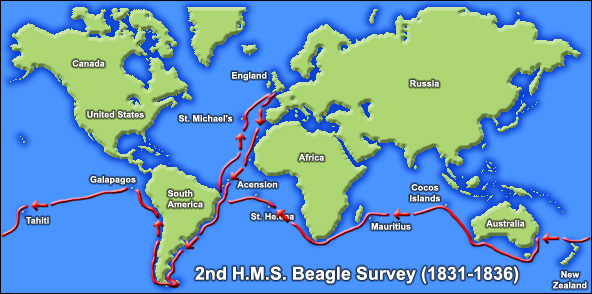

The Beagle was paid off on the 17th of November. The Beagle was put into commission on the 4th of July 1831; thus having completed the unusually long period of five years and one hundred and thirty six days.

---oOo---

28th October 1836


Greenwich
Got up the river to Greenwich on the 28th.

Captain Fitzroy’s Journal
On the 28th our anchor was let go at Greenwich.

Syms Covington Journal
The following morning were towed to Greenwich the 28th.

26th October 1836

Syms Covington Journal
Anchored off The Nore near to Chatham.  Anchored off Gravesend, was towed by steamer the same evening FOR about an hour and a half.

24th October 1836

Syms Covington Journal
Deal
Visitors came to see the ship the following morning. Sailed about 12 o'clock the same day, and came to our anchor about three or four hours afterwards. When near the flats, we were obliged to bring too in consequence of thick weather.

23rd October 1836

Syms Covington Journal
Anchored off Deal.

22nd October 1836

Syms Covington Journal
Anchored off Dungeness.

21st October 1836

Syms Covington Journal
Sailed from Dover the 21st 11 o'clock am

20th October 1836

Syms Covington Journal
Aanchored 20th 8 o'clock Dover

18th October 1836

Plymouth to Greenwich
Sailed for the Thames, calling on her way at Portsmouth & Deal….

Catching Up

[Barn Pool, where the Beagle lay before sailing.  One of the safest anchorages in the Hamoze, it lies across the Tamar opposite the King William Yard, Devonport]

As I am sure many will realise, with our daily dose of Darwin (Plus Fitzroy and Covington) now nearly come to its inevitable end I am missing their wonderful descriptions of the world of 1831-36.  But all is not lost.  The whole thing will remain here for new readers to 'catch up'... and I have decided myself to wind back to October 1832, with the Beagle in South America, and follow again their exploits day-by-day.

Additionally, for those who want to accompany me, James Cook's Endeavour voyage has now been running for a couple of months (click on the link  on the top right of this page).  With Cook, we are certainly in another age.... 63 years before the start of the Darwin voyage, the Endeavour having left Plymouth Sound in 1768 (Darwin 1831).

6th October 1836

CHARLES DARWIN TO J.S. HENSLOW.
Shrewsbury, Thursday, October 6, 1836.

My dear Henslow,

I am sure you will congratulate me on the delight of once again being home. The "Beagle" arrived at Falmouth on Sunday evening, and I reached Shrewsbury yesterday morning. I am exceedingly anxious to see you, and as it will be necessary in four or five days to return to London to get my goods and chattels out of the "Beagle", it appears to me my best plan to pass through Cambridge. I want your advice on many points; indeed I am in the clouds, and neither know what to do or where to go. My chief puzzle is about the geological specimens -- who will have the charity to help me in describing their mineralogical nature? Will you be kind enough to write to me one line by RETURN OF POST, saying whether you are now at Cambridge? I am doubtful till I hear from Captain Fitz-Roy whether I shall not be obliged to start before the answer can arrive, but pray try the chance. My dear Henslow, I do long to see you; you have been the kindest friend to me that ever man possessed. I can write no more, for I am giddy with joy and confusion.

Farewell for the present,
Yours most truly obliged,
CHARLES DARWIN.

---oOo---

CHARLES DARWIN TO R. FITZ-ROY.
Shrewsbury, Thursday morning, October 6, 1836.

My dear Fitz-Roy,

I arrived here yesterday morning at breakfast time, and, thank God, found all my dear good sisters and father quite well. My father appears more cheerful and very little older than when I left. My sisters assure me I do not look the least different, and I am able to return the compliment. Indeed, all England appears changed excepting the good old town of Shrewsbury and its inhabitants, which, for all I can see to the contrary, may go on as they now are to Doomsday. I wish with all my heart I was writing to you amongst your friends instead of at that horrid Plymouth. But the day will soon come, and you will be as happy as I now am. I do assure you I am a very great man at home; the five years' voyage has certainly raised me a hundred per cent. I fear such greatness must experience a fall.

I am thoroughly ashamed of myself in what a dead-and-half-alive state I spent the few last days on board; my only excuse is that certainly I was not quite well. The first day in the mail tired me, but as I drew nearer to Shrewsbury everything looked more beautiful and cheerful. In passing Gloucestershire and Worcestershire I wished much for you to admire the fields, woods, and orchards. The stupid people on the coach did not seem to think the fields one bit greener than usual; but I am sure we should have thoroughly agreed that the wide world does not contain so happy a prospect as the rich cultivated land of England.

I hope you will not forget to send me a note telling me how you go on. I do indeed hope all your vexations and trouble with respect to our voyage, which we now know HAS an end, have come to a close. If you do not receive much satisfaction for all the mental and bodily energy you have expended in His Majesty's service, you will be most hardly treated. I put my radical sisters into an uproar at some of the prudent (if they were not honest Whigs, I would say shabby) proceedings of our Government. By the way, I must tell you for the honour and glory of the family that my father has a large engraving of King George IV. put up in his sitting-room. But I am no renegade, and by the time we meet my politics will be as firmly fixed and as wisely founded as ever they were.

I thought when I began this letter I would convince you what a steady and sober frame of mind I was in. But I find I am writing most precious nonsense. Two or three of our labourers yesterday immediately set to work and got most excessively drunk in honour of the arrival of Master Charles. Who then shall gainsay if Master Charles himself chooses to make himself a fool. Good-bye. God bless you! I hope you are as happy, but much wiser, than your most sincere but unworthy philosopher,

CHAS. DARWIN.

5th October 1836

LETTER TO JOSIAH WEDGWOOD.
[Shrewsbury, October 5th, 1836.]


My dear Uncle
The "Beagle" arrived at Falmouth on Sunday evening, and I reached home late last night. My head is quite confused with so much delight, but I cannot allow my sisters to tell you first how happy I am to see all my dear friends again. I am obliged to return in three or four days to London, where the "Beagle" will be paid off, and then I shall pay Shrewsbury a longer visit. I am most anxious once again to see Maer, and all its inhabitants, so that in the course of two or three weeks, I hope in person to thank you, as being my first Lord of the Admiralty.


CHAS. DARWIN.

3rd October 1836

Captain Fitzroy’s Journal
From Falmouth we went to Plymouth.

Syms Covington Journal
Left Falmouth October 3rd pm, anchored in Plymouth.

2nd October 1836

Falmouth
After a tolerably short passage, but with some very heavy weather, we came to an anchor at Falmouth. To my surprise and shame I confess the first sight of the shores of England inspired me with no warmer feelings, than if it had been a miserable Portugeese settlement. The same night (and a dreadfully stormy one it was) I started by the Mail for Shrewsbury.

Captain Fitzroy’s Journal
Anchored at Falmouth, on the 2d of October, after an absence of four years and nine months from England.

Syms Covington Journal
Anchored in Falmouth pm Sunday October 1st, 1838.

[Today... in 1836 of course, Darwin's journey is complete. As you will see, he immediately left the Beagle and travelled up to Shrewsbury; but I will continue following the Beagle until the records cease. However, for us intrepid travellers, James Cook's Circumnavigation Journal may be followed each day -- click on the link on the top right of this page. We are just a month or so into our voyage with the Endeavour in 1768.]

1st October 1836


[Tonight... in 1838 of course, Darwin's journey is complete.  As you will see, he immediately leaves the Beagle and travels up to Shrewsbury; but I will continue following the Beagle until the records cease.  However, for us intrepid travellers, James Cook's Circumnavigation Journal may be followed each day -- click on the link on the top right of this page. We are just a month or so into our voyage with the Endeavour in 1768  It is interesting that is this penultimate diary entry, Darwin is thinking of... Captain James Cook!]


Azores to Falmouth
From seeing the present state, it is impossible not to look forward with high expectation to the future progress of nearly an entire hemisphere. The march of improvement, consequent on the introduction of Christianity through the South Sea, probably stands by itself on the records of the world. It is the more striking when we remember that but seventy years since, Cook, whose most excellent judgment none will dispute, could foresee no prospect of such change. Yet these changes have now been effected by the philanthropic spirit of the English nation.

In the same quarter of the globe Australia is rising, or indeed may be said to have risen, into a grand centre of civilization, which, at some not very remote period, will rule the empress of the Southern hemisphere. It is impossible for an Englishman to behold these distant colonies, without a high pride and satisfaction. To hoist the British flag seems to draw as a certain consequence wealth, prosperity and civilization.

In conclusion, — it appears to me that nothing can be more improving to a young naturalist, than a journey in distant countries. It both sharpens and partly also allays that want and craving, which as Sir J. Herschel remarks, a man experiences, although every corporeal sense is fully satisfied. The excitement from the novelty of objects, and the chance of success stimulates him on to activity. Moreover as a number of isolated facts soon become uninteresting, the habit of comparison leads to generalization; on the other hand, as the traveller stays but a short space of time in each place, his description must generally consist of mere sketches instead of detailed observation. Hence arises, as I have found to my cost, a constant tendency to fill up the wide gaps of knowledge by inaccurate & superficial hypotheses.

But I have too deeply enjoyed the voyage not to recommend to any naturalist to take all chances, and to start on travels by land if possible, if otherwise on a long voyage. He may feel assured he will meet with no difficulties or dangers (excepting in rare cases) nearly so bad as he before hand imagined. — In a moral point of view, the effect ought to be, to teach him good humoured patience, unselfishness, the habit of acting for himself, and of making the best of everything, or contentment: in short, he should partake of the characteristic qualities of the greater number of sailors. — Travelling ought also to teach him to distrust others; but at the same time he will discover how many truly good natured people there are, with whom he never before had, nor ever again will have any further communication, yet who are ready to offer him the most disinterested assistance.

30th September 1836


Azores to Falmouth
Amongst the other most remarkable spectacles, which we have beheld, may be ranked, — the stars of the Southern hemisphere, the water-spout — the glacier leading its blue stream of ice in a bold precipice overhanging the sea — a lagoon island, raised by the coral forming animalcule — an active volcano — the overwhelming effects of a violent earthquake. — These latter phenomena perhaps possess for me a higher interest, from their intimate connection with the geological structure of the world. The earthquake must however be to everyone a most impressive event; the solid earth, considered from our earliest childhood as the very type of solidity, has oscillated like a thin crust beneath our feet; and in seeing the most beautiful and laboured works of man in a moment overthrown, we feel the insignificance of his boasted power.

It has been said that the love of the chase is an inherent delight in man, — a relic of an instinctive passion. If so, I am sure the pleasure of living in the open air, with the sky for a roof, and the ground for a table, is part of the same feeling. It is the savage returning to his wild and native habits. I always look back to our boat cruizes & my land journeys, when through unfrequented countries, with a kind of extreme delight, which no scenes of civilization could create. I do not doubt every traveller must remember the glowing sense of happiness, from the simple consciousness of breathing in a foreign clime, where the civilized man has seldom or never trod.

There are several other sources of enjoyment in a long voyage, which are perhaps of a more reasonable nature. The map of the world ceases to be a blank; it becomes a picture full of the most varied and animated figures. Each part assumes its true dimensions: large continents are not looked at in the light of islands, or islands considered as mere specks, which in truth are larger than many kingdoms of Europe. Africa, or North & South America, are well-sounding names and easily pronounced, but it is not till having sailed for some weeks along small portions of their coasts, that one is thoroughly astonished.

29th September 1836

Azores to Falmouth
Among the scenes which are deeply impressed on my mind, none exceed in sublimity the primeval forests, undefaced by the hand of man, whether those of Brazil, where the powers of life are predominant, or those of Tierra del Fuego, where death & decay prevail. Both are temples filled with the varied productions of the God of Nature: — No one can stand unmoved in these solitudes, without feeling that there is more in man than the mere breath of his body. — In calling up images of the past, I find the plains of Patagonia most frequently cross before my eyes. Yet these plains are pronounced by all most wretched & useless. They are only characterized by negative possessions; — without habitations, without water, without trees, without mountains, they support merely a few dwarf plants. Why then, and the case is not peculiar to myself, do these arid wastes take so firm possession of the memory? Why have not the still more level, greener & fertile Pampas, which are serviceable to mankind, produced an equal impression? I can scarcely analyse these feelings. — But it must be partly owing to the free scope given to the imagination. They are boundless, for they are scarcely practicable & hence unknown: they bear the stamp of having thus lasted for ages, & there appears no limit to their duration through future time. If, as the ancients supposed, the flat earth was surrounded by an impassable breadth of water, or by deserts heated to an intolerable excess, who would not look at these last boundaries to man's knowledge with deep, but ill defined sensations. — Lastly of natural scenery, the views from lofty mountains, though certainly in one sense not beautiful, are very memorable. I remember looking down from the crest of the highest Cordillera; the mind, undisturbed by minute details, was filled by the stupendous dimensions of the surrounding masses.

Of individual objects, perhaps no one is more sure to create astonishment, than the first sight, in his native haunt, of a real barbarian, — of man in his lowest and most savage state. One's mind hurries back over past centuries, & then asks could our progenitors be such as these? Men, — whose very signs & expressions are less intelligible to us than those of the domesticated animals; who do not possess the instinct of those animals, nor yet appear to boast of human reason, or at least of arts consequent on that reason. I do not believe it is possible to describe or paint the difference of savage and civilized man. It is the difference between a wild and tame animal: and part of the interest in beholding a savage is the same which would lead every one to desire to see the lion in his desert, the tiger tearing his prey in the jungle, the rhinoceros on the wide plain, or the hippopotamus wallowing in the mud of some African river.

Syms Covington Journal
The ship ran at times ten knots and six tenths. The following morning it blew a heavy gale, so that the ship was hove too under a close reefed maintopsail and storm staysail at same time. We were about 500 miles from the Lands End. The sea went down greatly in course of the day.

28th September 1836

Azores to Falmouth
Let us now look at the brighter side of the past time. The pleasure derived from beholding the scenery and general aspect of the various countries we have visited, has decidedly been the most constant and highest source of enjoyment. It is probable that the picturesque beauty of many parts of Europe far exceeds anything we have beheld. But there is a growing pleasure in comparing the character of scenery in different countries, which to a certain degree is distinct from merely admiring their beauty. It more depends on an acquaintance with the individual parts of each view: I am strongly induced to believe that as in Music, the person who understands every note will, if he also has true taste, more thoroughily enjoy the whole; so he who examines each part of [a] fine view may also thoroughily comprehend the full and combined effect. Hence a traveller should be a botanist, for in all views plants form the chief embellishment. Group masses of naked rocks, even in the wildest forms; for a time they may afford a sublime spectacle, but they will soon grow monotomous; paint them with bright and varied colours, they will become fantastick; clothe them with vegetation, they must form, at least a decent, if not a most beautiful picture.

When I said that the scenery of Europe was probably superior to anything which we have beheld, I must except, as a class by itself, that of the intertropical regions. The two can not be compared together; but I have already too often enlarged on the grandeur of these latter climates. As the force of impression frequently depends on preconceived ideas, I may add that all mine were taken from the vivid descriptions in the Personal Narrative which far exceed in merit anything I have ever read on the subject. Yet with these high wrought ideas, my feelings were very remote from partaking of a tinge of disappointment on first landing on the coast of Brazil.

27th September 1836

Azores to Falmouth
If a person suffers much from sea sickness, let him weigh it heavily in the balance: I speak from experience, it is no trifling evil cured in a week. If he takes pleasure in naval tactics, it will afford him full scope for his taste; but even the greater number of sailors, as it appears to me, have little real liking for the sea itself.  It must be borne in mind how large a proportion of the time during a long voyage is spent on the water, as compared to the days in harbour. And what are the boasted glories of the illimitable ocean? A tedious waste, a desert of water as the Arabian calls it. No doubt there are some delightful scenes; a moonlight night, with the clear heavens, the dark glittering sea, the white sails filled by the soft air of a gently blowing trade wind, a dead calm, the heaving surface polished like a mirror, and all quite still excepting the occasional flapping of the sails.

It is well once to behold a squall, with its rising arch, and coming fury, or the heavy gale and mountainous waves. I confess however my imagination had painted something more grand, more terrific in the full grown storm. It is a finer sight on the canvass of Vandervelde, and infinitely finer when beheld on shore, when the waving trees, the wild flight of the birds, the dark shadows & bright lights, the rushing torrents all proclaim the strife of the unloosed elements. At sea, the albatross and petrel fly as if the storm was their proper sphere, the water rises and sinks as if performing its usual task, the ship alone and its inhabitants seem the object of wrath. On a forlorn & weather-beaten coast the scene is indeed different, but the feelings partake more of horror than of wild delight.

26th September 1836

Azores to Falmouth
Our voyage having come to an end, I will take a short retrospect of the advantages and disadvantages the pain & pleasure of our five years' wandering. If a person should ask my advice before undertaking a long voyage, my answer would depend upon his possessing a decided taste for some branch of knowledge, which could by such means be acquired. No doubt it is a high satisfaction to behold various countries, and the many races of Mankind, but the pleasures gained at the time do not counterbalance the evils. It is necessary to look forward to a harvest, however distant it may be, when some fruit will be reaped, some good effected. Many of the losses which must be experienced are obvious, such as that of the society of all old friends, and of the sight of those places with which every dearest remembrance is so intimately connected. These losses however, are at the time partly relieved by the exhaustless delight of anticipating the long wished for day of return. If, as poets say, life is a dream, I am sure in a long voyage these are the visions which best pass away the long night. Other losses, although not at first felt, after a period tell heavily, those are the want of room, of seclusion, of rest — the jading feeling of constant hurry — the privation of small luxuries, the comforts of civilization, domestic society, and lastly even of music & the other pleasures of imagination. When such trifles are mentioned, it is evident that the real grievances (excepting from accidents) of a sea life are at an end. The short space of sixty years has made a most astonishing difference in the facility of distant navigation. Even in the time of Cook, a man who left his comfortable fire side for such expeditions, did undergo privations: a yatch with every luxury of life might now circumnavigate the globe. Besides the vast improvements in ships & naval resources, the whole Western shores of America are thrown open; and Australia is become a metropolis of a rising continent. How different are the circumstances to a man shipwrecked at the present day in the Pacific, to what they would have been in the time of Cook: since his voyage a hemisphere has been added to the civilized world.